Beyond the Spreadsheet: How a CRM Can Help You Rethink Business Development
By Agatha Mouillet, Chris Orange
June 30, 2026 | 6-minute read
Sales and Networking Techniques Measure Message Effectiveness Technology Management Customer Relationship Management (CRM) Infographic
Business Development
Mid-size law firms that want to grow efficiently, strengthen client relationships, and prove return on investment (ROI) for business development efforts need the right tools and strategy. Yet many firms still rely on spreadsheets, siloed data, and informal tracking methods that limit visibility and decision-making. Implementing a customer relationship management (CRM) system transforms how firms capture, analyze, and act on client and referral data.
Strategic CRM adoption can drive measurable improvements in client development, marketing performance, and firm growth. CRM solutions can be tailored to fit any firm’s size, structure, and strategy. The right system scales with your firm and evolving business development goals.
The Pain Points That Lead Firms to CRM
For many law firms, business development has long operated on institutional memory, informal networks, and manually maintained spreadsheets. The result is a fragmented picture of the firm’s most valuable asset: its relationships.
Common pain points that drive firms toward CRM adoption include:
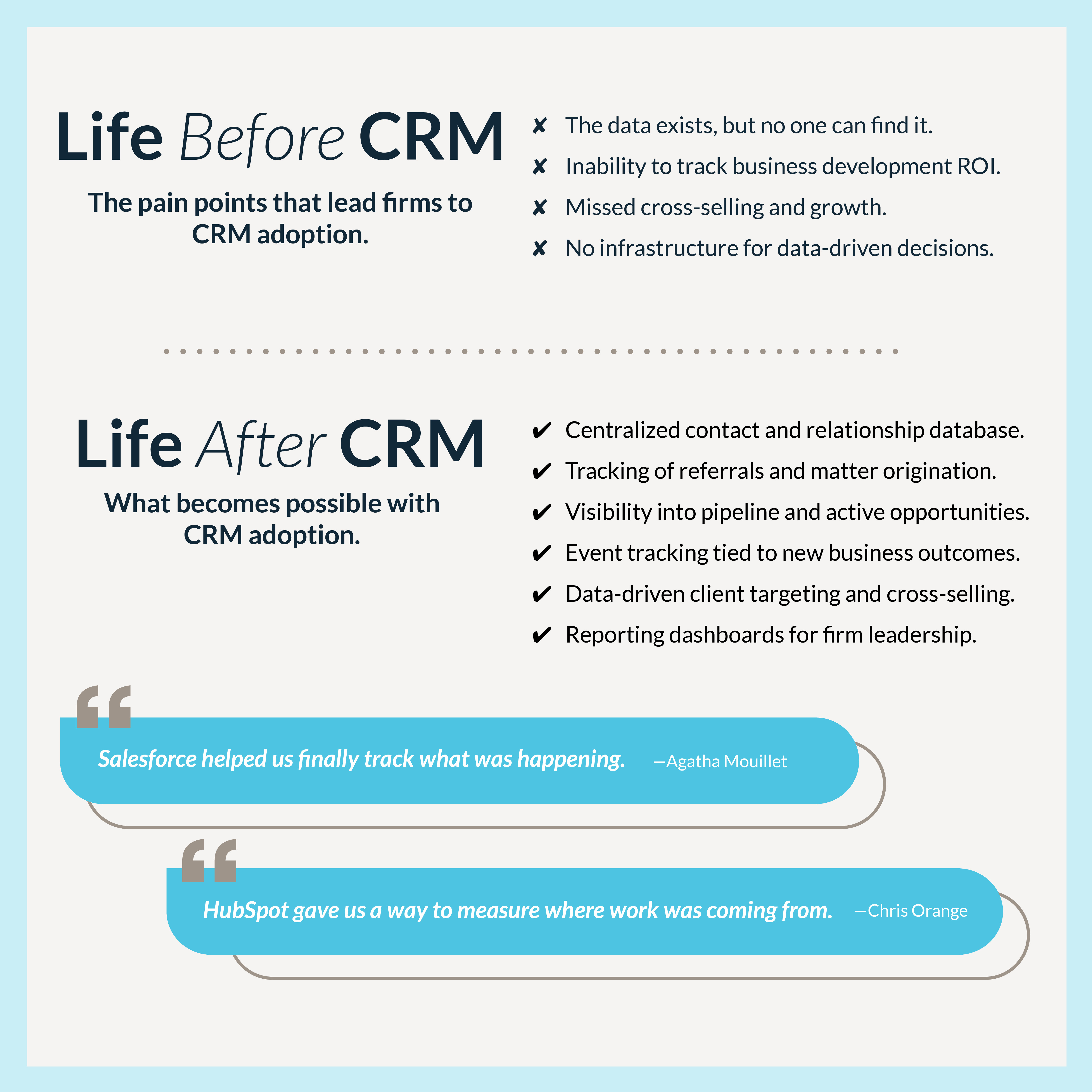
The data exists, but no one can find it: When contact records live in Outlook, event attendance in a spreadsheet, and matter history in the billing system, no one has the full picture. Firms often can’t answer basic questions, such as: Who referred this client? Which relationships are generating the most work? Which practice areas are underleveraged? Without centralized data, these insights are either unavailable or buried in someone’s mailbox, and follow-up depends entirely on individual attorneys remembering to act.
Inability to track business development ROI: Attorneys often attend conferences, host events, and pursue prospects for months. Without tracking this, there is no way to connect those activities to actual revenue. Firms may continue to invest in efforts that do not work while underinvesting in the ones that do.
Missed cross-selling and growth: Without visibility into clients' needs across practice areas, firms routinely miss opportunities to deepen existing relationships.
No infrastructure for data-driven decisions: Leadership can’t make informed decisions about where to invest business development resources, which client segments to pursue, or how to allocate marketing spend without reliable, centralized data.
What Becomes Possible With a CRM
A well-implemented CRM doesn’t just organize data; it changes how a firm thinks about and acts on its relationships and business development efforts. A few benefits include:
Centralized contact and relationship database: Every attorney, client, prospect, referral source, and alumni contact can live in one place. There are no duplicate records, outdated contact sheets, or relationship intelligence locked in an individual attorney’s Outlook. The firm network becomes a shared asset.
Tracking of referrals and matter origination: Using a CRM makes it possible to trace where work actually comes from: which relationships, which events, and which outreach efforts. Over time, this builds a better picture of the firm’s most valuable referral sources and informs where to invest relationship-building energy.
Visibility into pipeline and active opportunities: Attorneys and business development professionals can see where prospects are in the relationship cycle, what follow-up is pending, and which opportunities are at risk of going cold. Nothing falls through the cracks because someone forgot to follow up.
Event tracking tied to new business outcomes: CRM connects conference attendance, client dinners, webinars, and sponsorships to actual relationship development and new matters. Firms can begin to see patterns in which events generate meaningful relationship activity and which don’t.
Data-driven client targeting and cross-selling: With a complete view of client relationships and matter history, firms can identify which clients are good candidates for additional services and assign the right attorneys to deepen those relationships intentionally rather than opportunistically.
Reporting dashboards for firm leadership: Leadership gains real-time visibility into business development activity, pipeline health, marketing performance, and relationships across the firm. Decisions about where to invest resources are grounded in data.
Setting Your CRM Up for Success
A CRM can only deliver results if it’s implemented with the right strategy from the start.
Strategy and Selection
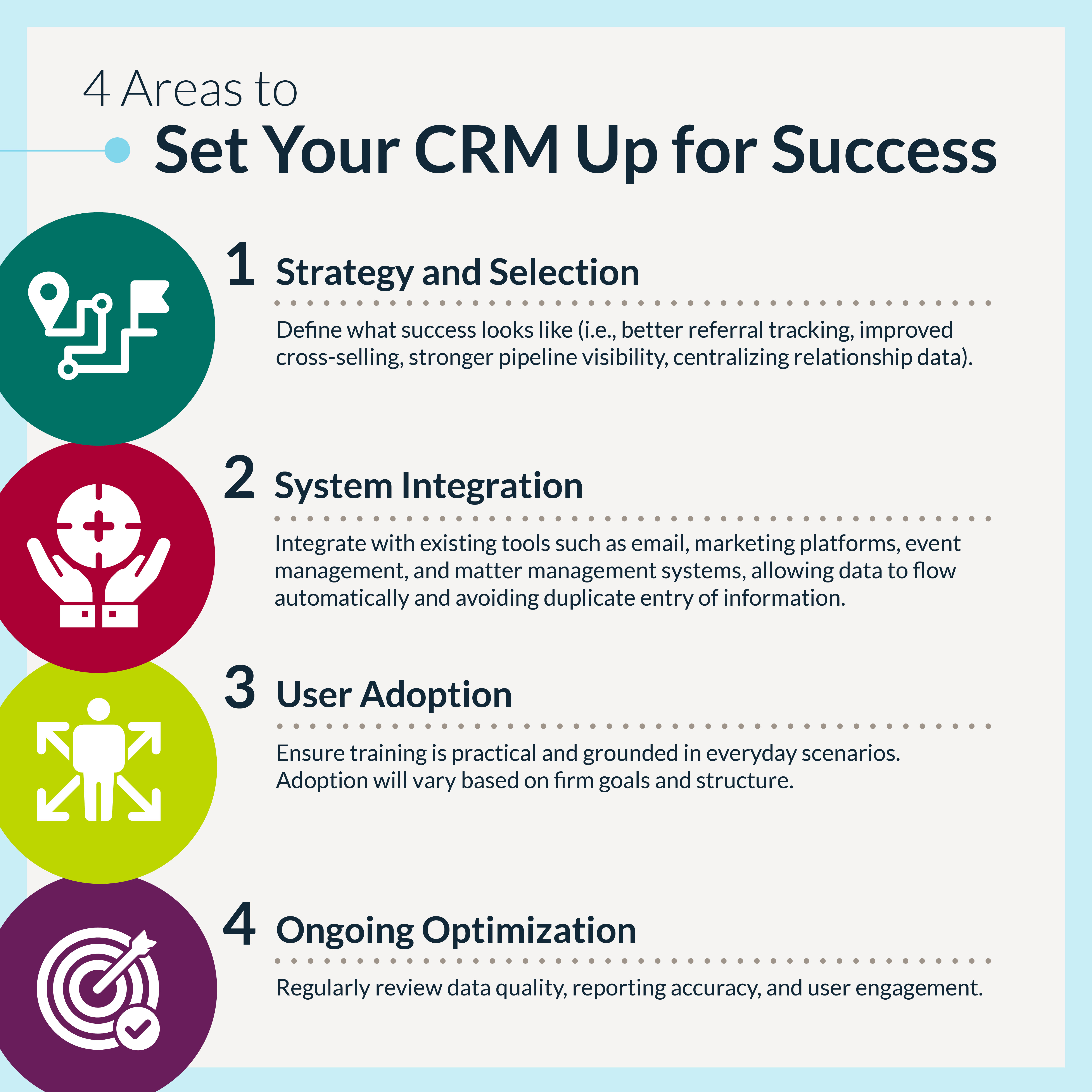
Start by defining what success looks like for your firm. For some, it can be better referral tracking, improved cross-selling, or stronger pipeline visibility. For others, particularly firms that aren’t actively seeking out new clients, success looks more like clarity: understanding how and why business comes in, centralizing relationship data that currently lives across inboxes and spreadsheets, and building a single source of truth for all business development activities.
System Integration
If it makes sense for your firm, integrate your CRM with your existing tools (emails, marketing platforms, event management, and matter management systems). This allows data to flow automatically, and attorneys aren’t asked to enter information twice.
That said, full integration doesn’t have to happen at once. Partial integration remains beneficial, improving data completeness and usability. You can start with core connectivity in Phase 1 and layer additional integrations as the firm grows more comfortable with the system.
User Adoption
Technology only works if people use it. Training should be grounded in the practical, everyday scenarios relevant to the people who will use the CRM. What adoption looks like will vary from firm to firm. Some firms train their attorneys to use the system; others choose to keep it primarily within the business development and marketing team, with attorneys contributing selectively. Either approach can work depending on your goals and your firm’s structure.
Ongoing Optimization
Implementation is not a finish line. Regularly reviewing data quality, reporting accuracy, and user engagement ensures the system continues to reflect the firm’s actual relationships and priorities and evolves as the firm grows.
Measuring ROI With CRM
One of the most significant shifts CRM enables is moving from activity-based business development to outcome-based business development, understanding not just what the firm is doing but what is actually working. Key metrics to track include:
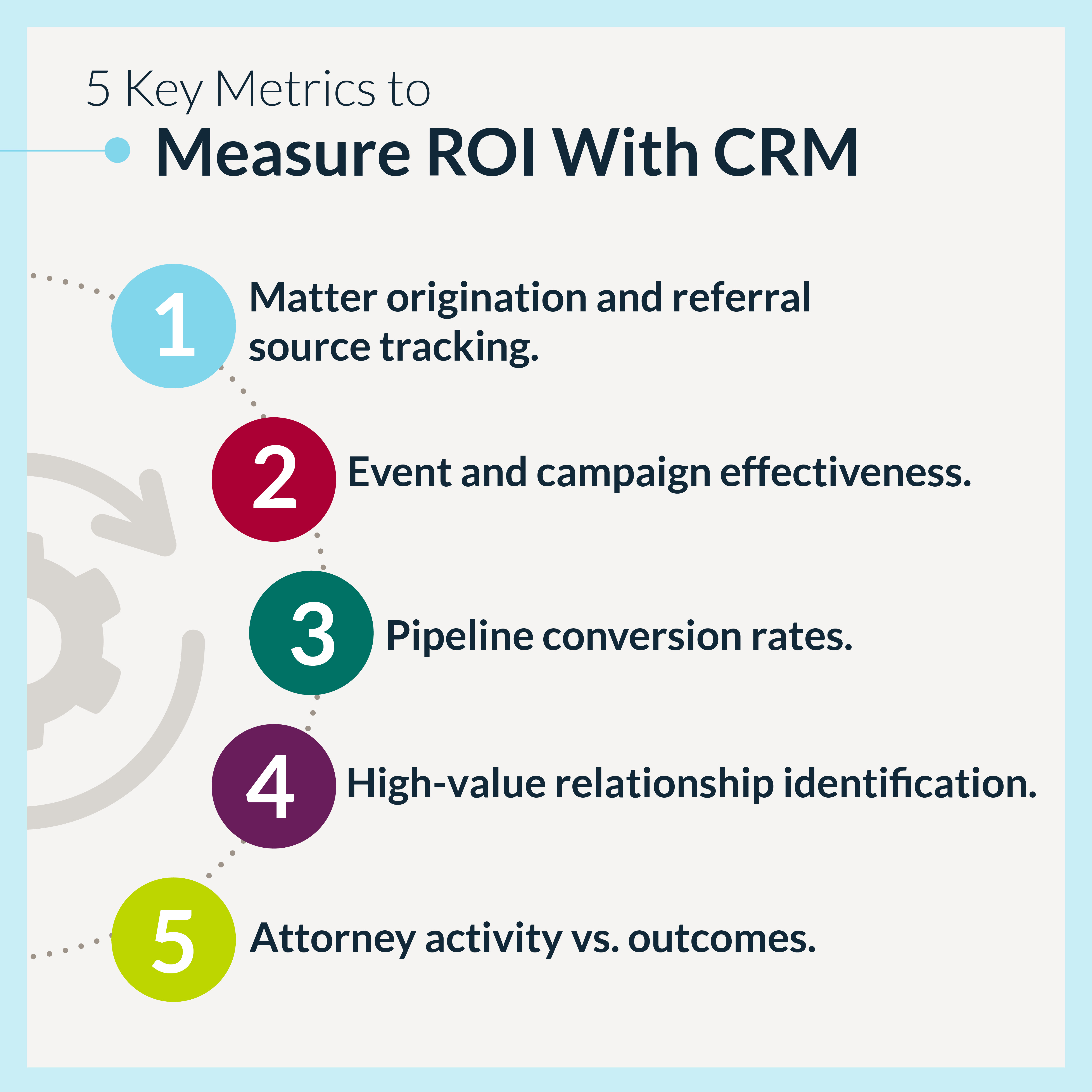
Matter origination and referral source tracking: Knowing where new work comes from is essential. Using a CRM enables the firm to attribute matters to specific relationships, referral sources, events, or campaigns, providing a factual basis for where to invest its business development energy.
Event and campaign effectiveness: Rather than evaluating events or attendance based only on attorney satisfaction, using a CRM allows firms to track whether participation translates into meaningful relationship development over time.
Pipeline conversion rates: Tracking how prospects move through the relationship cycles from initial contact to active opportunity and ultimately to retained clients. This helps reveal where momentum stalls and where follow-up efforts are most needed.
High-value relationship identification: CRM helps identify which relationships generate the most referrals, matters, or cross-practice activity. That insight helps firms deliberate on how to nurture their most productive connections.
Attorney activity vs. outcomes: Comparing business development activity levels with actual business outcomes helps firms understand which efforts are translating into results and which may need to be redirected.
Business Impact for Mid-Size Firms
The value of a well-implemented CRM extends beyond business development and can help the way the firm operates and makes decisions at every level.
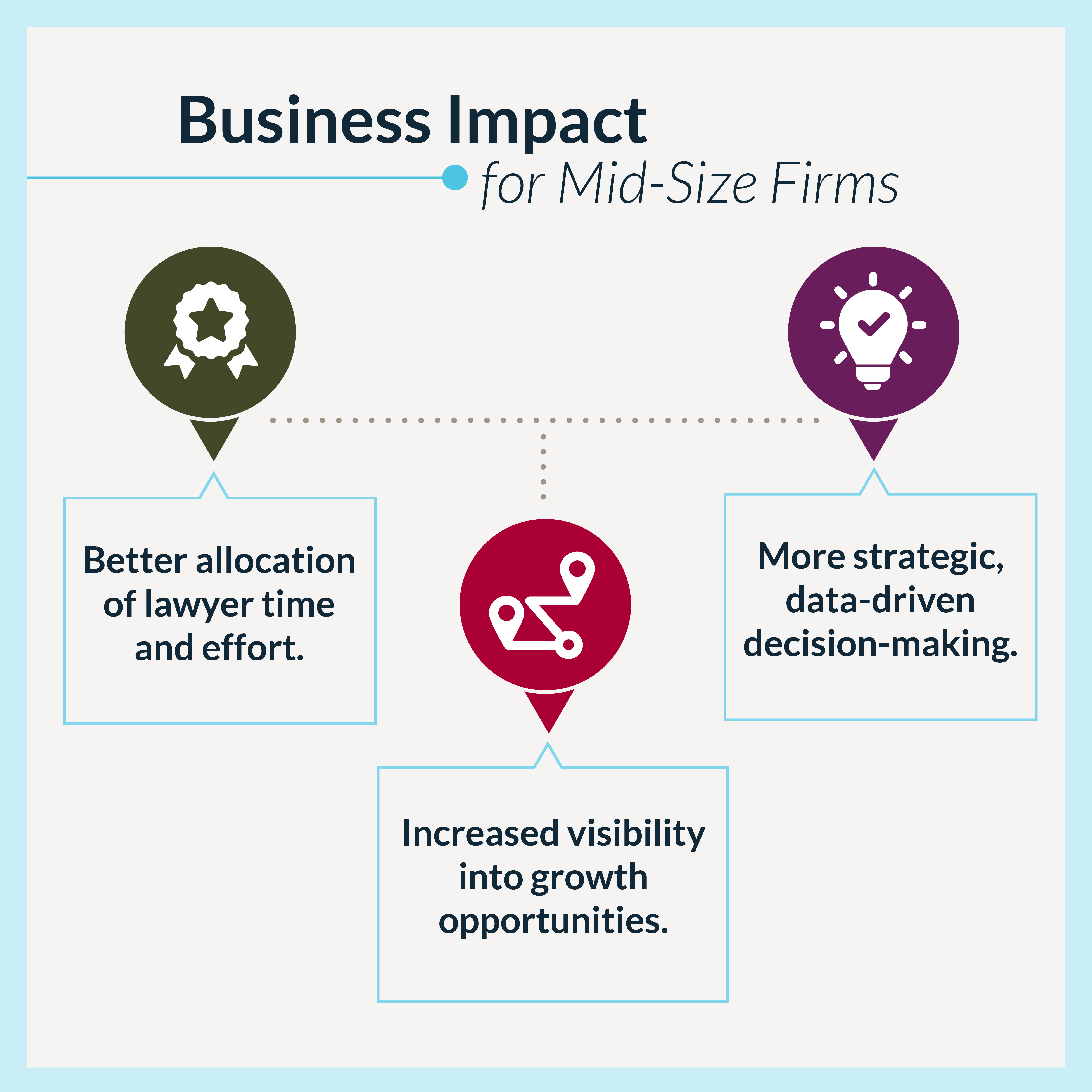
Better allocation of lawyer time and effort: When attorneys have visibility into which activities are generating work, they can be more intentional about where they invest their limited business development time. They focus more on opportunities likely to move the needle.
Increased visibility into growth opportunities: Growth opportunities that previously slipped through the cracks become visible and actionable. You can set reminders and follow-up actions to prevent things from being forgotten.
More strategic, data-driven decision-making: Firm leadership gains a clearer picture of what is driving revenue, which business development investments are paying off, and where to focus resources in the year ahead. Decisions that were once based on instinct or driven by seniority become grounded in evidence.
Key Considerations for CRM Adoption
CRM adoption is a meaningful investment in time, budget, and organizational change. Don’t rush the decision-making and selection process.
Cost vs. Long-term Value
The cost of a CRM (licensing, implementation, training, and ongoing maintenance) is a legitimate consideration for any firm. But it should be weighed against the less visible costs of operating without one: missed cross-sell opportunities, inconsistent follow-through, and business development decisions made without any reliable data.
Change Management Is Critical
The scope of a CRM implementation will vary, with some firms rolling it firmwide and others starting with just business development and marketing teams. But regardless of how many users are involved, the behavioral shift required is the same.
Even a small implementation changes how the firm thinks about and captures business development activity, and that shift in mindset is often harder than the technology itself. Bringing attorneys and staff along early, communicating the why, and addressing resistance directly are as critical as any technical consideration, whether you have five users or 50.
Even High-Performing Firms Benefit From Better Data
CRM is not just a fix for firms that are struggling. Even firms with strong reputations and healthy pipelines benefit from understanding their business more clearly — knowing which relationships to protect, which to develop, and where the next generation of work is likely to come from.
Learn More About Technology Management With the Third Edition of the LMA Body of Knowledge
The content in this feature correlates with the Technology Management domain in the LMA Body of Knowledge (BoK). Dive deeper and access the latest edition of the BoK online.
The Third Edition of the LMA BoK showcases enhanced expertise across every domain, introduces new competencies in Client Services, Communications and Technology Management, features more advanced skills across all domains and broadens coverage of competitive and business intelligence skills. Plus, it emphasizes a stronger commitment to nurturing diversity, equity, and inclusion across the entirety of the BoK. Learn more.
|