If Only We'd Known: Moving Client Relationships Beyond the Individual Partner
By Lee Blakemore
October 22, 2026 | 6-minute read
Competitive and Business Intelligence Process Improvement Client Services Process Improvement Infographic
Business of Law
Every law firm has experienced some version of the same conversation.
A partner announces their retirement. A key client contact moves to a new role. A high-profile lateral joins the firm but struggles to build internal connections. A referral source quietly disappears. Or two practice groups discover they've been pursuing the same client without realizing it.
Only then does someone say it:
"If only we'd known."
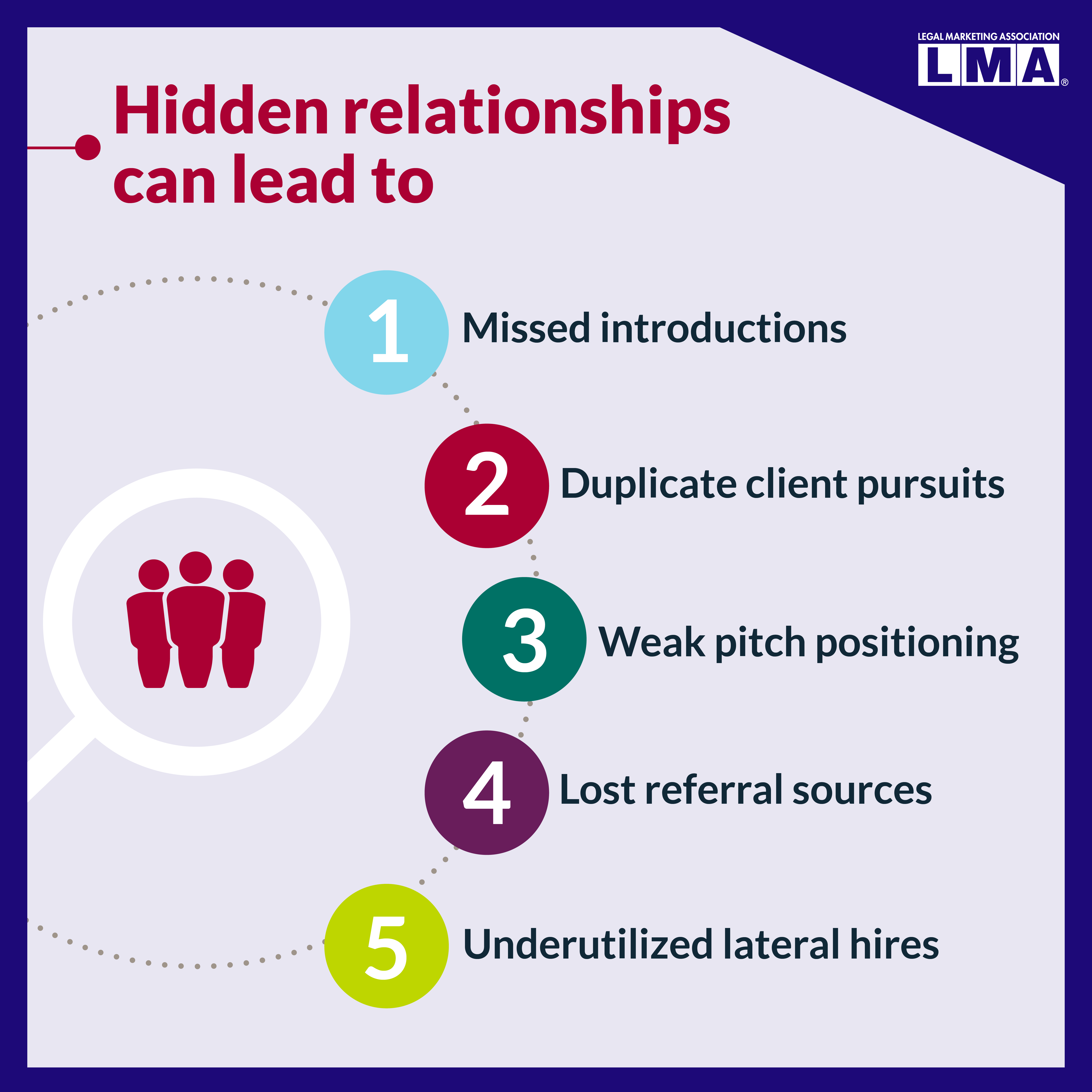
These moments rarely happen because firms lack talented lawyers, capable business development (BD) professionals, or sophisticated marketing teams. These moments happen at firms of every size, with talented lawyers and capable marketing teams. The pattern is always the same: Relationship knowledge stays with individuals and never makes it to the firm.
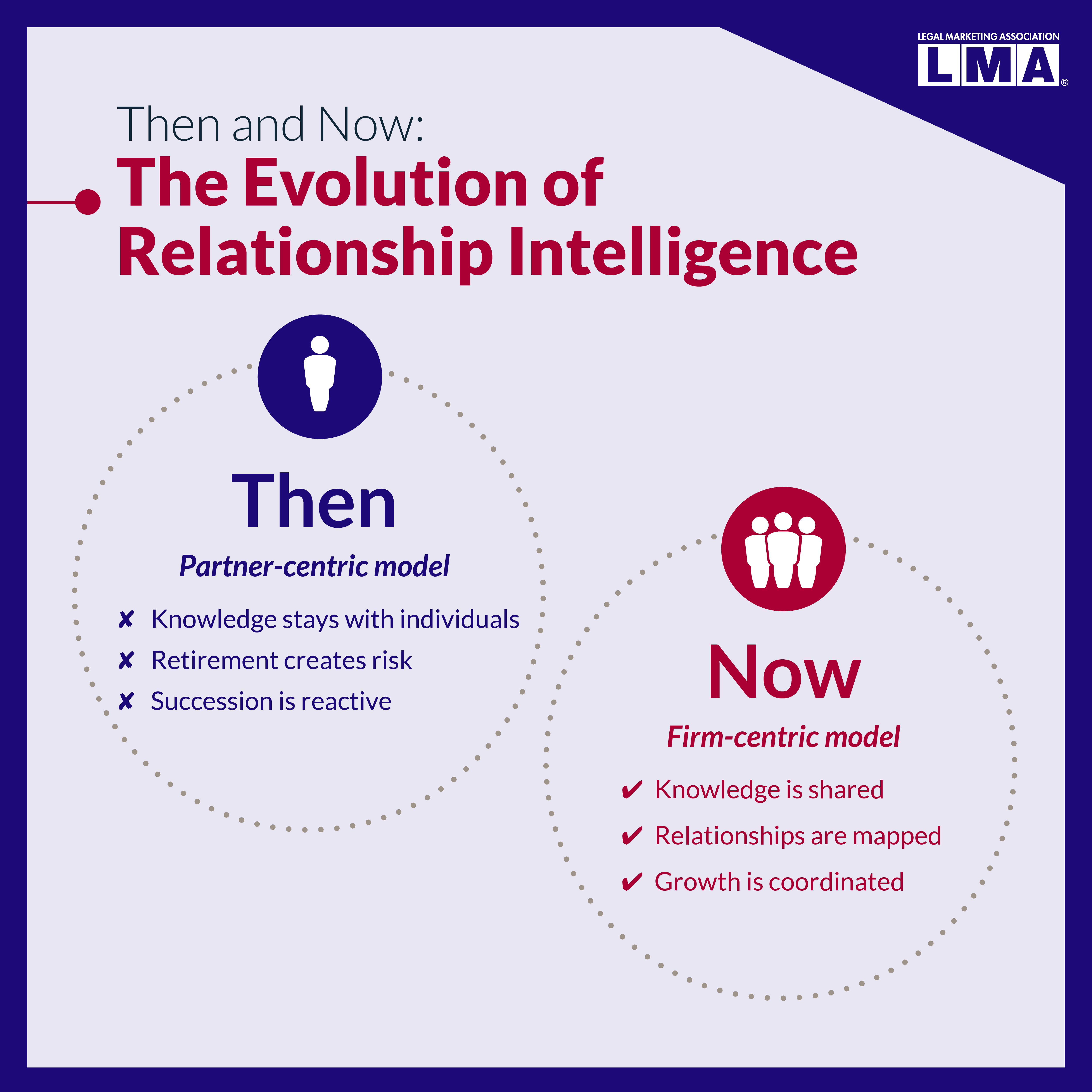
For decades, the traditional law firm model has centered on the individual partner. Clients hire lawyers they trust, and those personal relationships have fueled growth for generations. But as firms become more complex, client expectations evolve, and competition intensifies, relying on individual relationship ownership poses an increasingly significant business risk. There is an opportunity to change that by making relationship intelligence something the firm owns and builds on, rather than something it inherits or loses when someone walks in or out the door.
The challenge isn't replacing partner relationships. It's strengthening them by making relationship intelligence an institutional asset rather than an individual one.
For marketing and BD leaders, this presents an opportunity to move beyond supporting client development and help shape how firms protect, grow, and sustain their most valuable asset: trusted relationships.
These scenarios highlight a universal truth faced by firms of all sizes. Though hypothetical, they reflect common situations that marketing and BD professionals encounter daily and ultimately lead to the same conclusion.
If only we'd known.
The "Cold" Pitch That Wasn't Cold
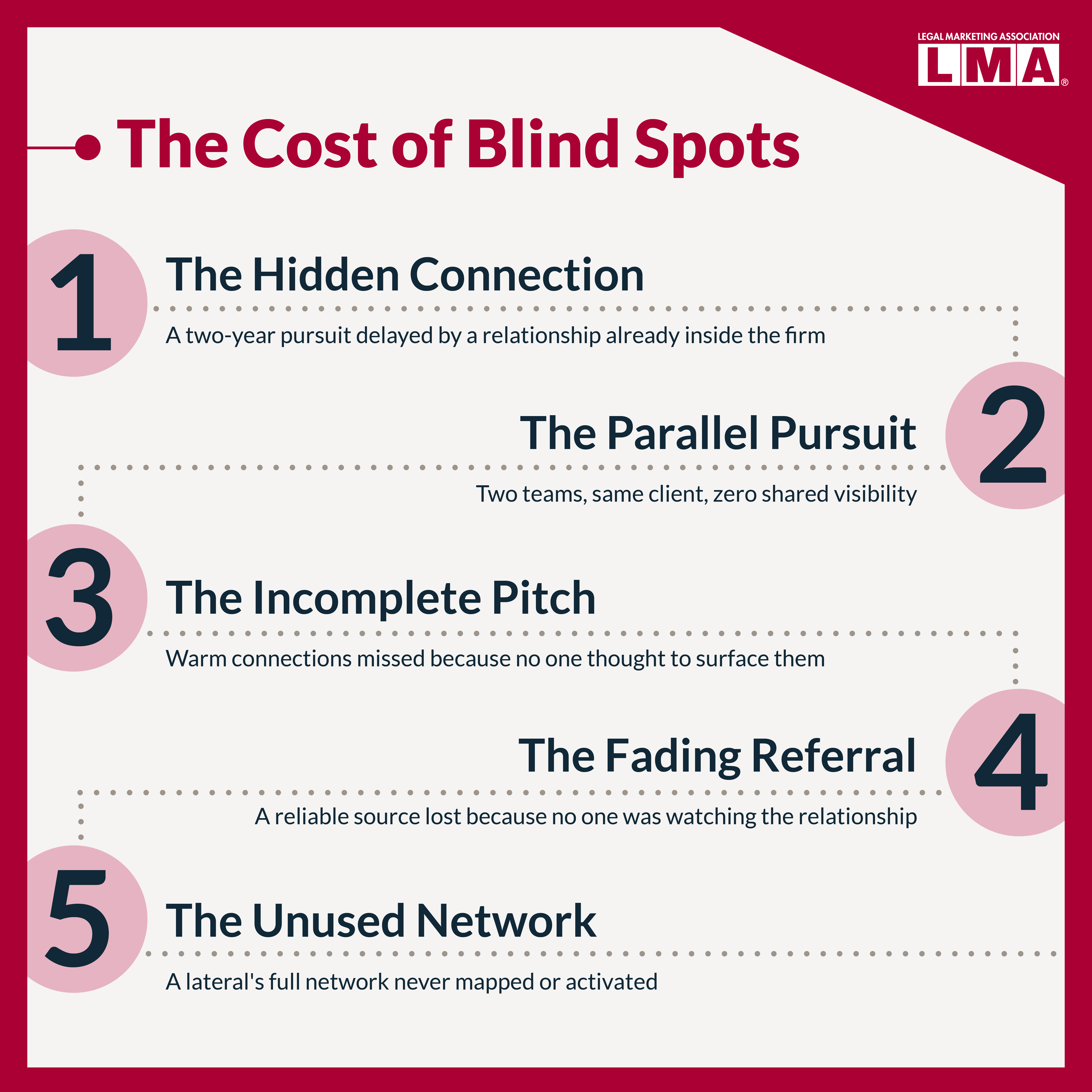
A corporate partner had spent nearly two years trying to get in front of a fast-growing private equity firm, and traction finally came when a trusted intermediary agreed to make an introduction. The team immediately went into pitch mode, building a credentials deck, researching recent transactions, and preparing for what everyone assumed would be the firm's first substantive conversation with the prospect.
A week before the meeting, someone casually mentioned over lunch that a restructuring partner had worked closely with the firm's CFO years earlier. It was a strong relationship, built over time, but it was never recorded anywhere. Not in the CRM, not in any pitch planning conversation, not through any internal process designed to surface it. No one withheld it deliberately. It simply never came up because no mechanism existed to uncover it.
The introduction that had taken years to engineer had been sitting within the firm all along. Two years of effort, held up by a connection no one thought to look for.
Two Teams. Same Client. No Idea.
The litigation group steadily built relationships within a fast-growing technology company while the corporate team pursued entirely separate opportunities with the same organization. Neither practice knew the other was making meaningful progress, and nothing in the way the firm operated would have revealed that overlap.
Marketing developed separate campaigns. BD supported two independent pursuits. Each team believed it was telling the firm's story, yet neither could see the full picture.
When the general counsel eventually asked which firm could provide a truly integrated approach across both matters, no one had a comprehensive answer. From the client's perspective, the firm seemed fragmented. It wasn't that the lawyers weren't collaborating. They simply lacked visibility into one another's relationships.
The Pitch Deck That Missed the Point
The BD team invested significant time preparing for a high-stakes credentials meeting, and the work showed. The research was thorough, the experience was relevant, and the presentation was polished, a careful reflection of everything the firm knew about the prospect.
What no one realized was that two partners at the firm had longstanding relationships with executives at the prospect's parent company. Connections built over years of shared work, kept entirely in personal email threads and memory. Nothing in the pitch preparation process would have flagged them, and neither partner thought to mention them. Not out of reluctance but because decades of relationship-building generate a long list, and without a prompt, most of it stays invisible.
The issue wasn't that partners intentionally withheld information. Most simply didn't think to share every relationship they'd built over decades of practice. Likewise, BD professionals can't pursue context they don't know exists. Without a structured way to uncover relationship intelligence, firms often enter important meetings looking far less connected than they are.
The Referral Relationship That Quietly Disappeared
For years, a regional accounting firm had been one of the practice group's most reliable referral sources for middle-market M&A work. When the referrals began to slow, it registered as noise rather than a signal. Work ebbs and flows, and no single month looked alarming on its own.
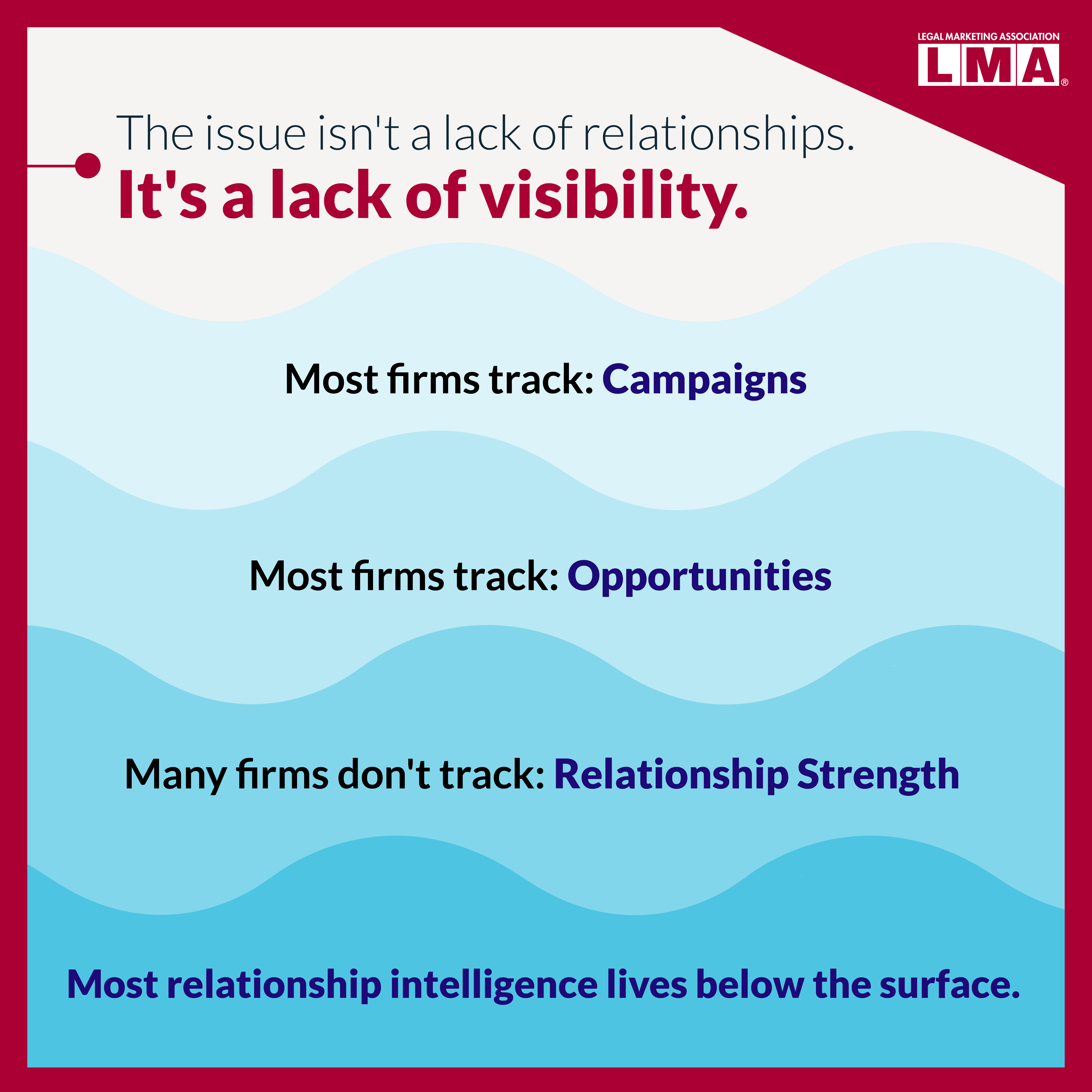
The problem was that no one was watching the relationship itself. Marketing focused on campaign performance, and BD measured active opportunities. No one monitored the referral relationship because no one owned that broader view.
By the time someone connected the dots, the accounting firm had already established a preferred relationship with a competing law firm. The signals had been around for months, maybe even longer. Nobody paid attention because no one realized it was part of their responsibilities.
The Lateral Who Brought a Network the Firm Never Used
When a nationally recognized partner joined the firm, leadership celebrated the move with all the expected fanfare: announcements, internal introductions, client outreach, and integration meetings. Early success was measured by the clients who followed through the door, and by that measure, things had gone well.
A year later, the partner’s broader network built across a career remained largely untouched. Former colleagues, board members, private equity contacts, referral sources, and industry executives all remained connected to a single individual rather than joining the firm's broader relationship ecosystem. No one had ever mapped where those relationships intersected with existing clients, strategic pursuits, or cross-selling opportunities.
The firm successfully integrated a lawyer but never fully integrated the network. In today's relationship-driven marketplace, that network may be worth just as much long-term value as the portable book of business itself.
The Common Thread
None of these situations stemmed from a lack of effort or commitment. In every example, capable lawyers, marketers, and BD professionals were doing good work. What was missing was visibility: a shared, structured picture of who knows whom, and what those connections are worth to the firm.
As firms place greater emphasis on client experience, succession planning, cross-selling, and long-term growth, relationship intelligence is becoming a strategic capability rather than an administrative exercise. Firms that surface hidden connections, share institutional knowledge, and build a more complete picture of their client relationships are better positioned to respond quickly, collaborate effectively, and protect the trust they've spent years earning.
Marketing and BD teams are uniquely positioned to lead that evolution. By helping firms shift from partner-held relationships to firmwide relationship intelligence, they can play a pivotal role in ensuring that clients remain connected not only to an individual lawyer but also to the firm as a whole.
Learn More About Client Services With the Third Edition of the LMA Body of Knowledge
The content in this feature correlates with the Client Services domain in the LMA Body of Knowledge (BoK). Dive deeper and access the latest edition of the BoK online.
The Third Edition of the LMA BoK showcases enhanced expertise across every domain, introduces new competencies in Client Services, Communications and Technology Management, features more advanced skills across all domains and broadens coverage of competitive and business intelligence skills. Plus, it emphasizes a stronger commitment to nurturing diversity, equity, and inclusion across the entirety of the BoK. Learn more.
|