Measuring What Matters: KPIs for Strategic Key Account Management
By Jacqueline Burns
September 01, 2026 | 6-minute read
Client Feedback Firm and Practice Strategy and Planning Financial Management and Measurement Client Services Internal Client Communications and Feedback External Client Communications and Feedback Customer Relationship Management (CRM)
Business Development
In law firms, account management is often treated as a soft, relationship-driven function rather than a disciplined capability with defined accountability and measurable outcomes. That perception is both outdated and costly. Firms that cannot measure the health of their most important client relationships are effectively flying blind — often discovering that an account is at risk only after the warning signs have passed.
If firms expect account leaders — whether fee earners or business development professionals — to protect revenue, strengthen relationships, and identify growth opportunities, they should establish key performance indicators (KPIs) that reflect those responsibilities.
Modern account leadership should be assessed not only by commercial outcomes but also by the behaviors and activities that create future growth. In my experience, the strongest programs consider five dimensions of strategic account management, organized into two distinct tiers.
Tier 1: Outcome Measures
Outcome measures reflect what the firm has achieved: revenue and growth, and relationship strength. These are lagging indicators and confirm that the right things have been happening. Firms that only measure outcomes are always looking backward.
Tier 2: Enabling Measures
Enabling measures reflect how the firm is working: the quality of strategic engagement, internal collaboration, and client experience. These are leading indicators. They provide early signals of future financial performance, inform revenue forecasting, and give leadership the confidence to invest in an account before the numbers demand it.
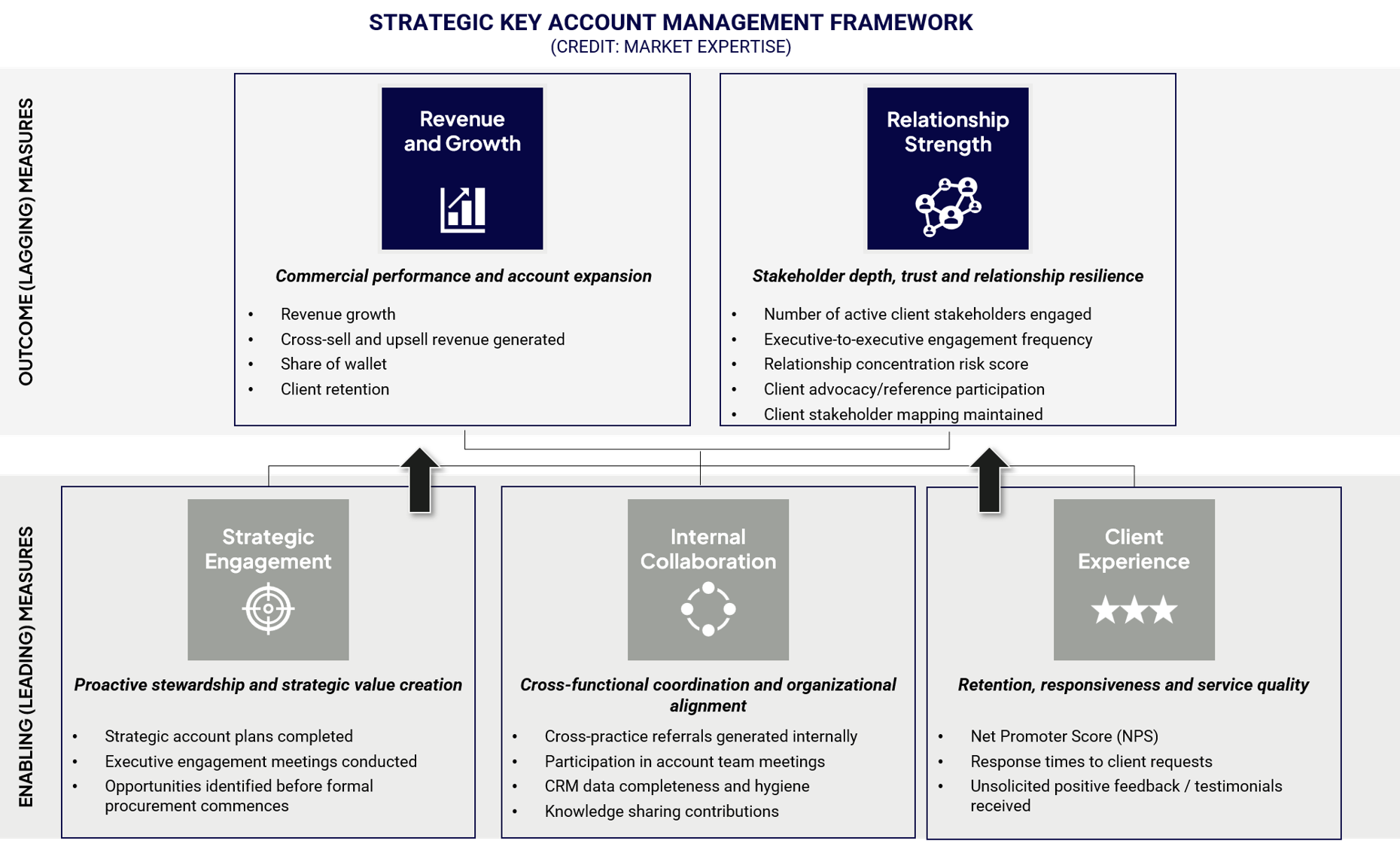
Let’s explore the two tiers further, starting with the lagging indicators, or the outcome measures.
Outcome Measure No. 1: Revenue and Growth
Commercial performance is the most visible measure of account health, but revenue alone can be misleading. A large account may appear financially healthy, while relationship depth, stakeholder engagement, and client satisfaction deteriorate beneath the surface. By the time revenue declines, the relationship may already be lost.
KPIs should include:
- Revenue growth
- Cross-sell and upsell revenue generated
- Share of wallet
- Client retention
Client retention belongs in this tier because the loss of a client is ultimately the loss of all future revenue from that relationship. Retention also is the ultimate lagging indicator — the proof that relationship investment has worked or the evidence that it has not.
Outcome Measure No. 2: Relationship Strength
Many firms fail to measure the actual strength and resilience of their client relationships, creating dangerous blind spots.
David Maister, one of the most influential thinkers on professional service firms, introduced the concept of zipper relationships: aligning practitioners with their hierarchical counterparts throughout the client organization so that multiple relationships exist at multiple levels. If only one practitioner maintains meaningful client contact, the account is more fragile than leadership realizes. The departure of that individual — or their counterpart at the client — can unravel years of goodwill overnight. Zipper relationships also deepen a firm’s institutional knowledge, making it easier to identify and resolve issues and cross-sell services.
A useful measure that few firms currently track is relationship concentration risk: the degree to which an account depends on a small number of relationships on either side. Sophisticated firms increasingly monitor:
- Number of active client stakeholders engaged
- Executive-to-executive engagement frequency
- Relationship concentration risk score
- Client advocacy and reference participation
- Client stakeholder mapping maintained and current
Outcomes should rarely come as a surprise to law firms — particularly not to firms that pay attention to the leading indicators, or the enabling measures.
Enabling Measure No. 1: Strategic Engagement
The best account leaders are proactive. They do not wait for instructions. They are constantly thinking about and for their clients, anticipating needs before they are articulated and positioning the firm before opportunities formally come to market.
This dimension separates account managers who service clients from those who steward them strategically. It also is one of the strongest leading indicators available. A firm that is conducting regular strategic reviews, identifying emerging client risks, and facilitating innovation discussions is a firm that is building pipeline, even when no opportunity is yet visible.
KPIs should assess whether account leaders are:
- Completing strategic account plans
- Conducting executive engagement meetings
- Identifying opportunities before formal procurement commences
- Facilitating innovation or strategic value discussions with clients
Enabling Measure No. 2: Internal Collaboration
Strategic client relationship management is a team sport. Strong client outcomes depend on cross-functional collaboration, knowledge sharing, coordinated service delivery and CRM discipline. An account leader, however talented, who operates in isolation is squandering opportunities.
Internal collaboration metrics are leading indicators of both client experience and commercial growth. A firm that shares knowledge across business units, generates internal referrals, and maintains high-quality account data is a firm that builds the infrastructure for account expansion.
Useful KPIs include:
- Cross-practice referrals generated internally
- Participation in account team meetings
- CRM data completeness and hygiene
- Knowledge sharing and client intelligence contributions
Enabling Measure No. 3: Client Experience
Client experience metrics are among the most reliable early signals of relationship trajectory. A client who responds promptly, participates in reference activities, and provides unsolicited positive feedback is signaling future intent. A client who becomes slower to engage, harder to reach, or more transactional in their interactions is signaling risk.
Firms should not wait for annual surveys to assess relationship health. Continuous listening and proactive engagement are essential.
KPIs might include:
- Net Promoter Score (NPS), measuring how likely clients are to recommend the firm
- Response times to client requests
- Unsolicited positive feedback and testimonials received
Measure What Actually Matters
One of the biggest risks in law firms is measuring account leaders solely on short-term revenue outcomes. That approach rewards transactional behavior and penalizes the relationship investment that precedes commercial growth.
The leading indicators — strategic engagement, internal collaboration, and client experience — will not always be visible in quarterly revenue reports, but they are the conditions under which revenue certainty is built. Firms that track them are not just measuring relationships more thoughtfully; they are building a more reliable intelligence system.
The strongest key account programs recognize that trust, stakeholder depth, and relationship resilience consistently precede commercial growth. Firms that wait for revenue to confirm what the leading indicators were already telling them will always be reacting.
As law firms increasingly institutionalize strategic client relationships, relationship management must become more structured, measurable, and governed.
Learn More About Client Services With the Third Edition of the LMA Body of Knowledge
The content in this feature correlates with the Client Services domain in the LMA Body of Knowledge (BoK). Dive deeper and access the latest edition of the BoK online.
The Third Edition of the LMA BoK showcases enhanced expertise across every domain, introduces new competencies in Client Services, Communications and Technology Management, features more advanced skills across all domains and broadens coverage of competitive and business intelligence skills. Plus, it emphasizes a stronger commitment to nurturing diversity, equity, and inclusion across the entirety of the BoK. Learn more.
|