What Is an MSO and Why Does It Matter?
By Suzanne Donnels
September 03, 2026 | 8-minute read
Business of Law Business Structures and Trends Profitability and Pricing Financial Management and Measurement Budgeting Project and Program Management
Marketing Management and Leadership
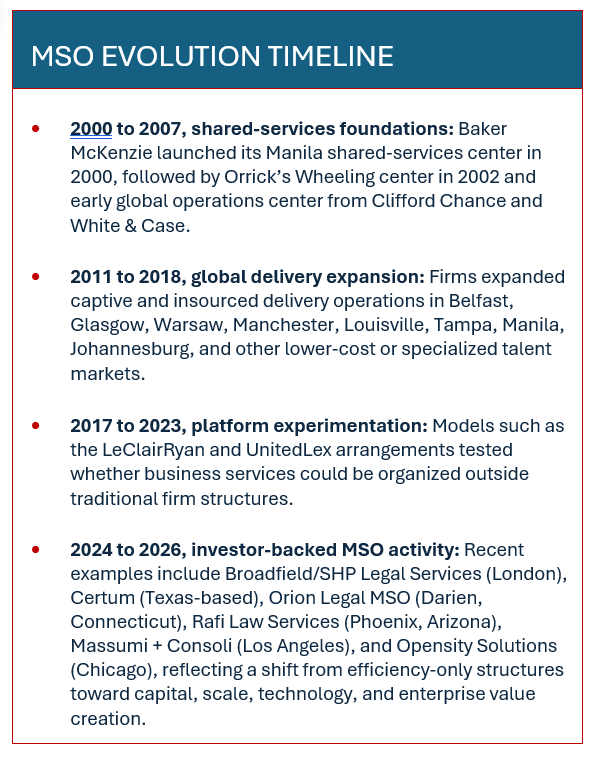
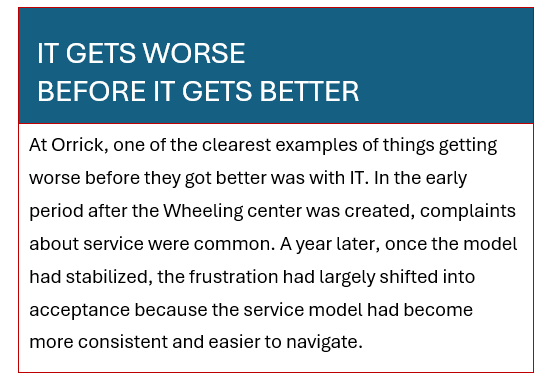
 Law firm shared-services models are not new. Baker McKenzie established a shared-services center in Manila in 2000. Two years later, while I was at Orrick, the firm moved a significant portion of its back-office operations to Wheeling, West Virginia, creating the first U.S. insourcing center of a U.S.-based law firm. Other firms then followed suit. These were the operational predecessors to today’s legal managed services organizations (MSOs).
These law-firm-owned or captive centers showed that the economics could be compelling, but the practical experience demonstrated that changing where and how business services are delivered is never just operational — it hits right into the culture of a firm. That is why renewed interest in MSOs deserves attention. MSOs may signal a broader shift in how law firms organize capital, talent, technology, client service, and growth functions.
This article is educational, not intended to advocate for or against MSOs, related private equity (PE) investment, or PE-backed law firm models. It explains what MSOs are, why they are surfacing now, how captive centers differ from investor-backed models, and what legal marketers and business development (BD) leaders should watch.
 What Is an MSO?
An MSO is a separate operating entity that provides some or all of a law firm’s business, administrative, technology, and sometimes legal-delivery support services under a dedicated services model. In newer investor-backed models, an MSO can also provide a structure through which outside investors fund and own nonlegal operations while the law firm remains lawyer-owned.
Depending on the model, services may include finance, IT, human resources, marketing, BD, pricing, project management, knowledge management, contract lawyers, legal analysts, or eDiscovery teams.
These models take different forms. One MSO may serve a single firm as a dedicated or captive services entity. Another may support multiple firms, practice groups, offices, or external clients, creating something closer to a professional services platform.
Reliable marketwide data remains limited because MSOs are often private business arrangements. Still, industry observers reported roughly a dozen legal MSO deals in 2025, and advisors continue to note interest from small and midsize firms seeking capital, scale, technology investment, and stronger infrastructure.
Captive shared-services centers have existed since 2000. Investor-backed, dual-entity MSOs appear to have accelerated more recently, especially in 2025 and 2026.
 Why Are We Hearing About MSOs Now?
“Law firms are kind of like that last frontier… Private equity is now going after them.”
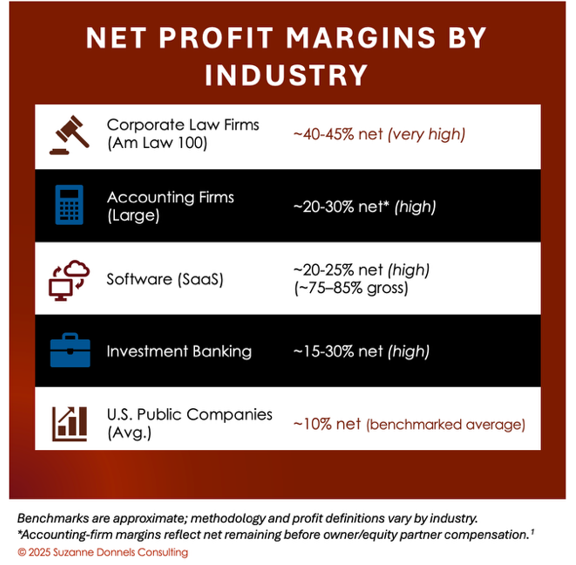
That observation from Lee Minkoff of Renovus Capital Partners, quoted by Jon Campisi in Law.com International, captures one reason MSOs are part of the law firm management conversation. Legal services can be attractive to investors because many firms combine strong margins, steady cash flow, sticky clients, and relatively low capital expenditure. The barrier has been regulation, especially rules restricting nonlawyer ownership and fee sharing.
Australia, the United Kingdom, and some other jurisdictions permit forms of nonlawyer ownership or alternative business structures. Most U.S. states do not, with Arizona the most prominent exception. Many U.S. investor-backed MSOs are therefore structured, so the law firm remains lawyer-owned and delivers legal services while a separate entity manages business infrastructure, technology, personnel, and operations.
In many investor-backed models, the management-services agreement is the economic bridge between the law firm and the MSO. The firm pays the MSO for services, often through fees designed to reflect the cost, scope, and expected value of the business infrastructure being provided. Because fee-sharing and nonlawyer ownership rules limit direct investment in many jurisdictions, these arrangements can give investors exposure to the economics of a law firm without owning the legal practice itself. When an investor later exits, the value being sold is not the law firm’s legal practice, but the contractual right to provide services and receive the related management fees.
For investors, the appeal is access to a high-margin professional services sector and being able to charge the lawyers a predictable fee for the delivery of business services support[1]. For law firms, the appeal may be better-funded infrastructure and operating discipline than the traditional partnership model can easily provide. Firms that lack the brand strength to attract top talent or the capital to fund long-term investments may find this model appealing.
PE investors also bring a different business operations mindset. Along with a more disciplined approach, they will ask tough questions — what drives enterprise value, which services should be centralized or scaled, where is data reliable enough to guide investment, and which business services activities produce measurable return. Even law firms that never accept outside capital may be influenced by that discipline as competitors adopt more sophisticated operating models.
How Do Captive Centers Differ From Investor-Backed MSOs?
Captive centers belong in the discussion because they reflect the same operating impulse: separating, centralizing, standardizing, and sometimes relocating business services to improve scale, consistency, and cost. Earlier service centers were largely captive, single-firm operations built around labor arbitrage, standardization, and follow-the-sun support.
Investor-backed MSOs are different. A captive center is owned and controlled by one firm. Newer PE-backed MSO structures co-own or solely own the nonlegal assets, technology, personnel, and infrastructure that then deliver business services support under a management-services agreement.
The hardest questions arise where formal structure meets daily practice. Lawyers may retain authority over client selection and legal advice, but when key business-services functions sit inside the MSO, including staffing models, budgets, technology, analytics, and performance measures, those functions can still shape how legal work is performed. That makes the management-services agreement central because it defines fees, services, duration, termination rights, adjustment provisions, and control of infrastructure. AI adds another issue: strategic value may sit in data, work product, model improvements, and workflow design. If those assets are controlled mainly by the MSO, influence can shift there.
 How Should Success Be Measured?
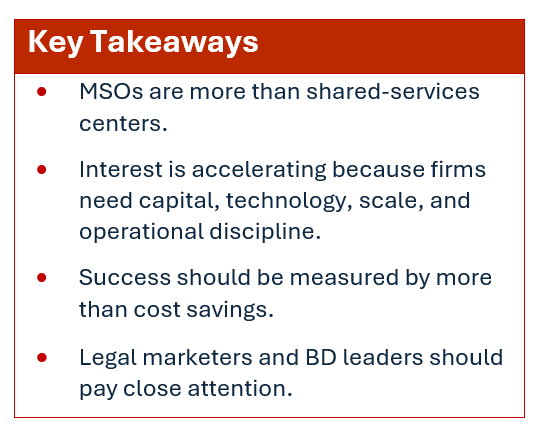
MSO success should not be measured only by reduced cost. Savings may be the easiest business case, but a lower-cost operation that frustrates lawyers, weakens client service, or distances business professionals from strategy and day-to-day relationships with the lawyers they support is not a successful model.
Leaders should evaluate both financial and nonfinancial outcomes: profitability, client satisfaction, retention, workforce enablement through technology, partner satisfaction, cultural connection, professional judgment, ethics, client trust, confidentiality, conflicts management, and whether business professionals can influence strategy rather than merely process work. The elephant in the room is one of culture. If you are seeking to create a one-firm culture, then shifting 50% of the firm into a PE-financed separate entity sends a clear message about what one firm means.
Why Should Legal Marketing and BD Leaders Care?
For legal marketing and BD leaders, the central question is whether the function is designed and measured as a driver of growth, client insight, and market strategy, or as a centralized service built mainly for efficiency. That distinction will shape structure, investment, reporting lines, metrics, and influence.
On the positive side, an MSO could deliver stronger infrastructure: better CRM discipline, integrated financial and client data, clearer matter and experience information, stronger proposal processes, AI-enabled workflows, and more consistent technology investment. A multi-firm MSO could also offer broader career opportunities and movement within the portfolio.
This is where PE-style thinking matters. It rewards repeatable processes, reliable data, clear accountability, and measurable value creation. That could elevate marketing and BD teams that connect clients, markets, pricing, technology, and firm economics, and expose teams that cannot explain their contribution in business terms.
The practical test is governance. Are teams invited into decisions about client growth, pricing, industry focus, and relationship development, or are they evaluated mainly on turnaround time, volume, and unit cost?
In a relationship business, the criteria should include proximity to lawyers and clients, access to reliable data, authority to challenge assumptions, and accountability for growth outcomes. A well-designed MSO could strengthen that connection. A poorly designed one could separate strategic judgment from the people, markets, and conversations that give the work value.
Legal marketers should not wait until MSOs are fully formed to understand them. The opportunity is to help define effective marketing and BD support before the measures of value are set by others.
What Comes Next?
LMA will host a roundtable discussion on this timely topic for its CMO members. Stay tuned for more details from LMA on the date, time, and how to join.
As MSOs continue to play a role in the legal marketing space, there will be opportunity to continue the conversation, going deeper into the workforce questions this primer introduces: how MSOs may affect marketing and BD careers, reporting lines, advancement paths, professional identity, culture, and the balance between efficiency and strategic influence.
[1]The American Lawyer, The 2025 Am Law 100 (FY2024 results).
AICPA & CPA.com, 2025 National Management of an Accounting Practice (MAP) Survey Executive Summary.
Benchmarkit, 2025 B2B SaaS Performance Metrics Benchmarks.
Aswath Damodaran, NYU Stern School of Business, Margins by Sector (US), January 2026.
Learn More About the Business of Law With the Third Edition of the LMA Body of Knowledge
The content in this feature correlates with the Business of Law domain in the LMA Body of Knowledge (BoK). Dive deeper and access the latest edition of the BoK online.
The Third Edition of the LMA BoK showcases enhanced expertise across every domain, introduces new competencies in Client Services, Communications and Technology Management, features more advanced skills across all domains and broadens coverage of competitive and business intelligence skills. Plus, it emphasizes a stronger commitment to nurturing diversity, equity, and inclusion across the entirety of the BoK. Learn more.
|